History: Sharing by Dr Lin Hongxuan
Explore Dr Lin Hongxuan's insights on Indonesia's separatist movements and the tensions between national unity and regional identities that have shaped the modern state.
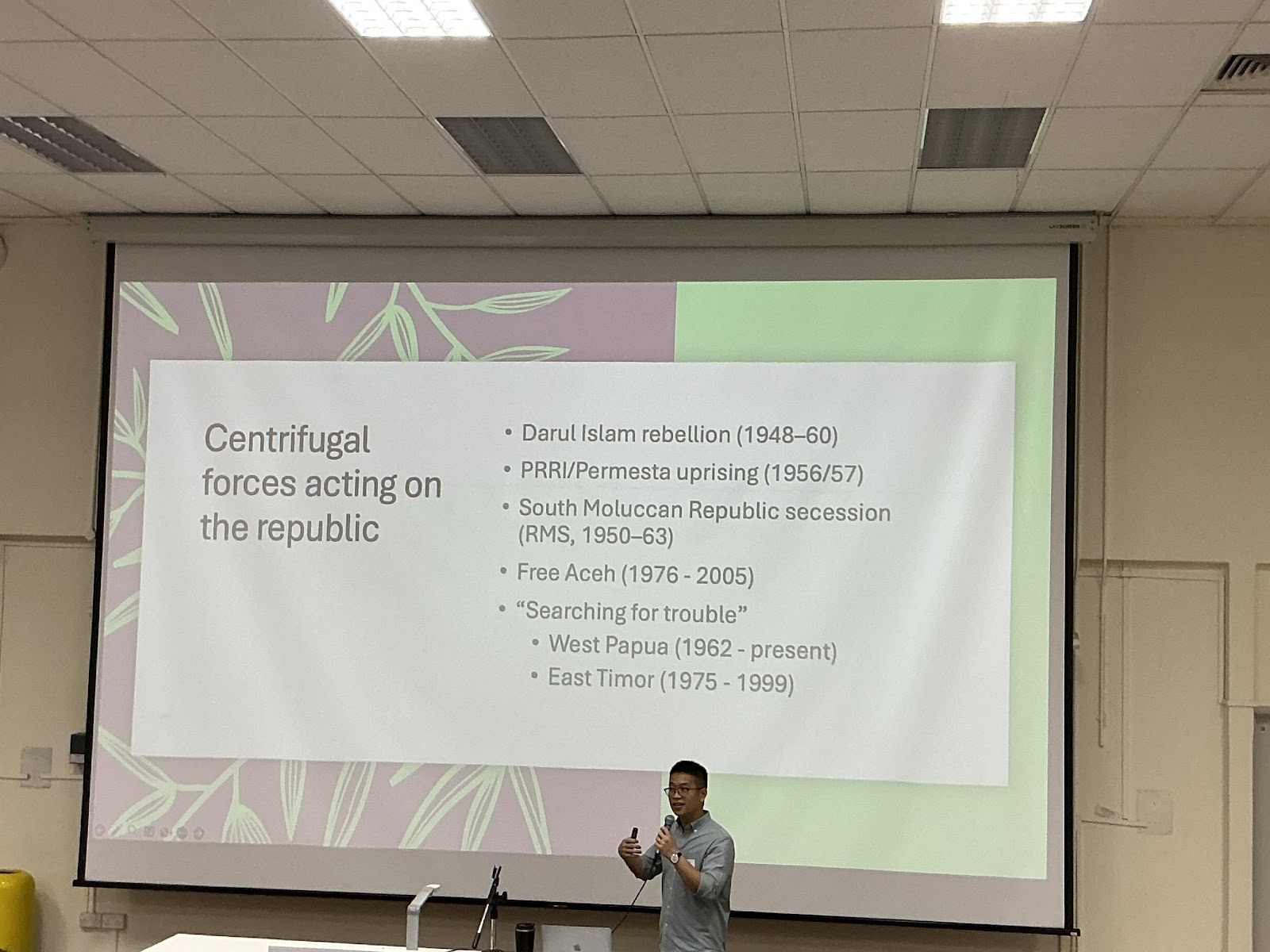
On 21 May 2025, our college had the privilege of hosting Dr. Lin HongXuan, Assistant Professor from the Department of Southeast Asian Studies at the National University of Singapore. Dr. Lin shared his expertise on the evolution of separatist movements in Indonesia from 1945 to the present day.
As a multi-ethnic and multi-religious nation, Indonesia embodies the profound concept of diversity. While inclusive national narratives and state ideologies often project an idealistic image of a nation that successfully broke the shackles of colonial rule, the modern state is also a byproduct of that very colonial brutality—a legacy that requires significant time, effort, and lived experience to reconcile.
As highlighted in the lecture, Indonesia’s confrontational history with Dutch rule set a precedent for the use of armed force to resolve differing visions of the state, particularly during the Sukarno and Suharto eras. These clashing perspectives range from the Darul Islam rebellion, which sought to establish Islam as the state religion, to Papuan nationalists who view the central government as a colonial successor infringing upon their resources and rights.
Through this session, I came to realise that while the 'idealism' of Pancasila promotes a multi-religious state with a goal of common humanity, it has historically risked paying mere lip service to these values while suppressing dissenting voices. As Indonesia matures, it must find space for these marginalised perspectives and accept even 'inconvenient' historical truths to prevent a return to civil strife.
Ultimately, I found it incredibly insightful to learn about these obscure yet vital historical movements, which are essential to appreciating the nuances of the modern state. Furthermore, this session offered a fascinating glimpse into the Department of Southeast Asian Studies, shedding light on their diverse approach to the region—exploring history not just through the lens of the state, but through culture, film, and social practices.
- Roy Goh, 2MD5